
Anime is one of the most claimed categories on YouTube, and the advice circulating about it is mostly wrong. The phrase that causes the most damage is fair use, because a great many creators treat it as a rule that applies everywhere, to anything, as long as you add commentary. It is an American doctrine, it is a defence rather than a permission, and Japanese law does not have it.
Here is how clip use actually works, what the difference between a strike and a Content ID claim is, and what happened to the people who pushed it furthest. General information, not legal advice.
Uploading a clip is reproduction before anything else
Putting anime footage into a video reproduces the work and makes it available to the public. Both are rights the copyright owner holds, in Japan under Articles 21 and 23 and in the United States under section 106. That is the starting point for every clip video, including reviews, essays, reactions, edits and compilations. Whether the use is permitted comes afterwards, and it depends entirely on which country’s law you are asking about.
The United States asks whether it is fair use
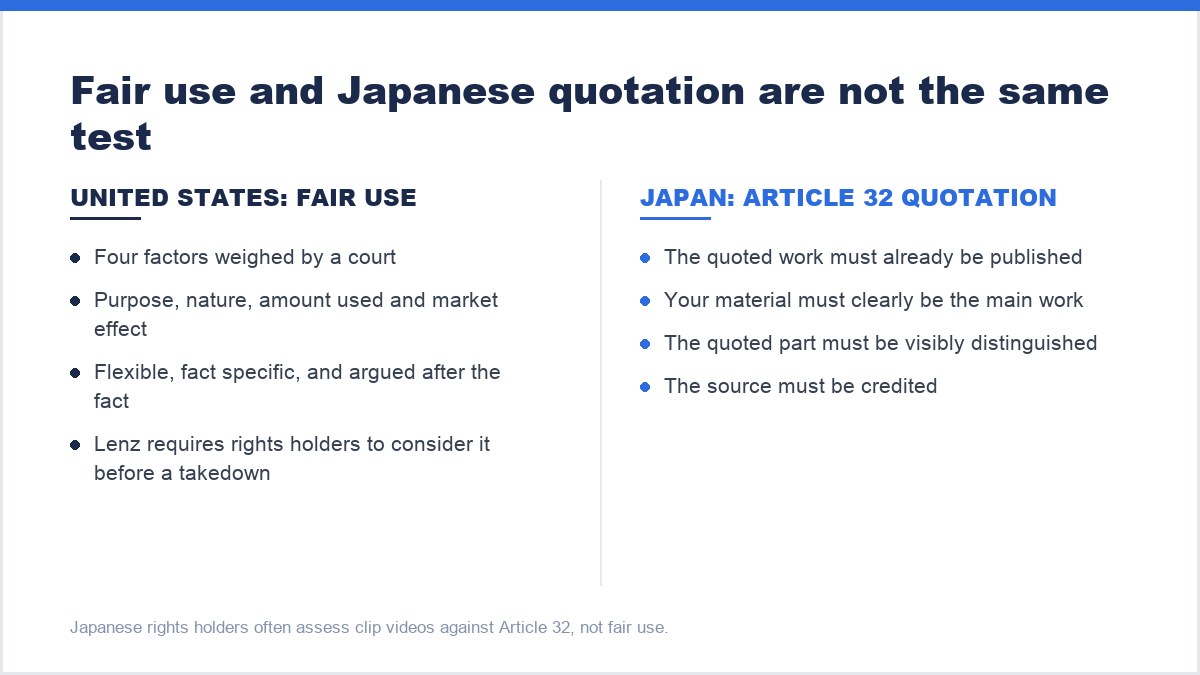
Section 107 asks a court to weigh four factors: the purpose and character of the use, the nature of the work, the amount used, and the effect on the market for the original. Criticism, comment, scholarship and news reporting are named as the kinds of purposes that can qualify.
Clip use does best when your own material dominates, when the footage is used to illustrate a point you are making rather than to deliver the content itself, and when a viewer could not substitute your video for the show. It does worst when the clips carry the video, when you have used the dramatic highlights, and when someone could watch yours instead of the episode.
Two cases are worth knowing. In Lenz v. Universal the Ninth Circuit held in 2015 that a rights holder must consider whether a use is fair before sending a takedown notice. In Hosseinzadeh v. Klein a New York federal court held in 2017 that a reaction video using substantial clips with running commentary was fair use. Neither case makes reaction or commentary automatically safe. Both show that the analysis turns on how much of your video is actually yours.
Japan has no fair use, it has quotation
This is the part English language guidance usually skips. Japanese copyright law contains no general fairness test. It has a list of specific exceptions, and the relevant one for clips is the quotation right in Article 32.
A lawful quotation in Japan has to meet conditions that are stricter and far more concrete than fair use. The quoted work must already be published. The quotation must be consistent with fair practice and no broader than the purpose requires. Your own material must clearly be the main work and the quoted material clearly subordinate to it, a relationship Japanese practice calls master and servant. The quoted part must be visibly distinguished from your own. And the source must be credited.
The rights holder is usually Japanese, and many will assess your video against Article 32 rather than against fair use. A video that an American lawyer might call transformative can still fail the Japanese test, most often on the master and servant requirement, because the clips are doing most of the work.
A strike and a Content ID claim are not the same thing
These get conflated constantly and the consequences are completely different.
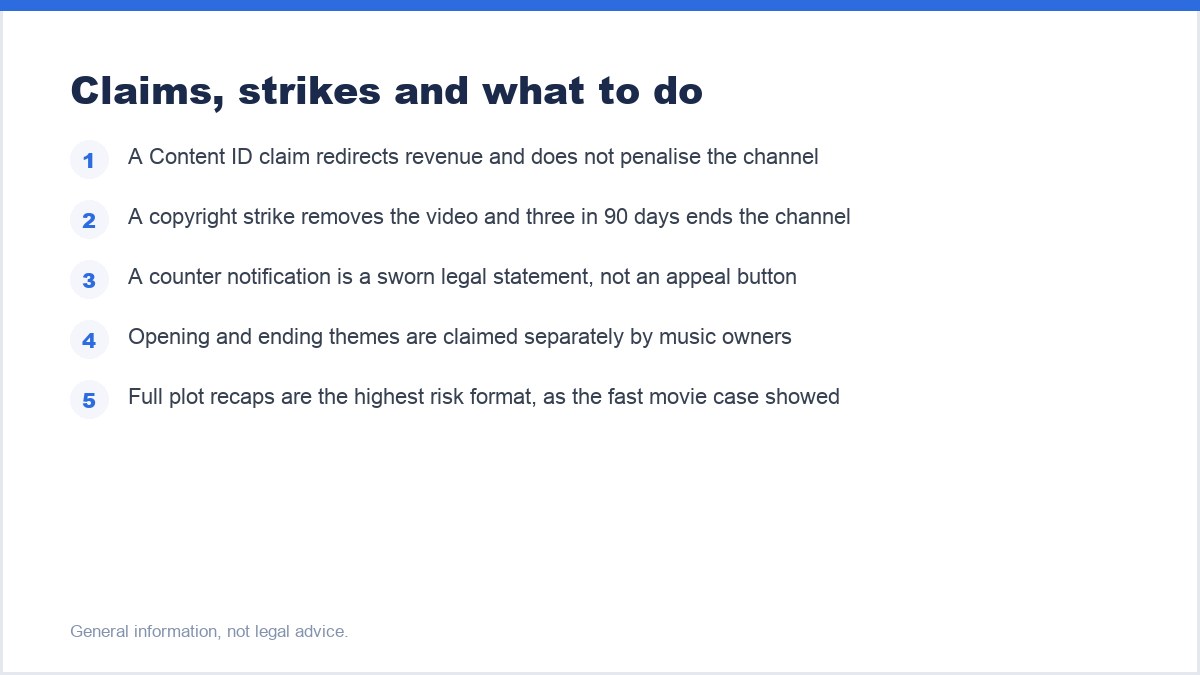
- A Content ID claim is automated. The rights holder’s reference file matched your video, and they have chosen to monetise it, track it, or block it. Revenue goes to them. It is not a penalty, it does not affect your channel standing, and three of them do not do anything to your account.
- A copyright strike is a formal legal takedown request made by a person. It removes the video and it counts against the channel. Three strikes in ninety days terminates the channel.
- A counter notification is a sworn legal statement, not an appeal button. It requires you to consent to the jurisdiction of a court and gives the rights holder a window to sue. It is the right tool when your use is genuinely lawful and the wrong tool when you are guessing.
Anime videos also attract claims from a direction people forget. Opening themes, ending themes and insert songs are frequently owned by a music company rather than by the anime’s rights holder, and they are registered in Content ID separately. A clip can be cleared on the video and claimed on the music.
The fast movie case shows where the ceiling is
Japan dealt with the most extreme version of clip use directly. Fast movies are edited recaps, roughly ten minutes long, that use footage with narration and subtitles to deliver an entire plot. Arrests began in 2021, the first for that format.
In November 2022 the Tokyo District Court ordered two uploaders to pay 500 million yen, around 3.5 million dollars, to thirteen film companies. The court reached the figure by multiplying roughly ten million views by 200 yen per view. The pair had earned about 7 million yen in advertising revenue from the videos. The damages were therefore around seventy times what they made.
Anime recap channels run the same format on television series. The reasoning in that judgment applies to them directly: when your video tells the whole story, the viewer no longer needs the original, and the market harm is the entire value of the work.
Practical rules that hold up
- Make your own material the substance of the video. Commentary over a clip is not the same as a clip inside an argument.
- Use the least footage that makes your point, and avoid the climactic scenes.
- Never let the video substitute for watching the episode. Full plot recaps are the highest risk format there is.
- Credit the series, the studio and the rights holder on screen and in the description. It is required for Japanese quotation and it costs nothing.
- Expect music claims separately from video claims.
- Treat a counter notification as a legal step, not a form.
- Check whether the rights holder publishes guidelines. Several Japanese companies now set out what they permit, and permission beats any argument about whether a use would have been lawful.
The underlying point is the one that runs through all of this. Copyright systems are relaxed about work that adds something and unforgiving about work that replaces the original. The same logic separates fan art from fan translation, and it separates a video essay from a recap.