

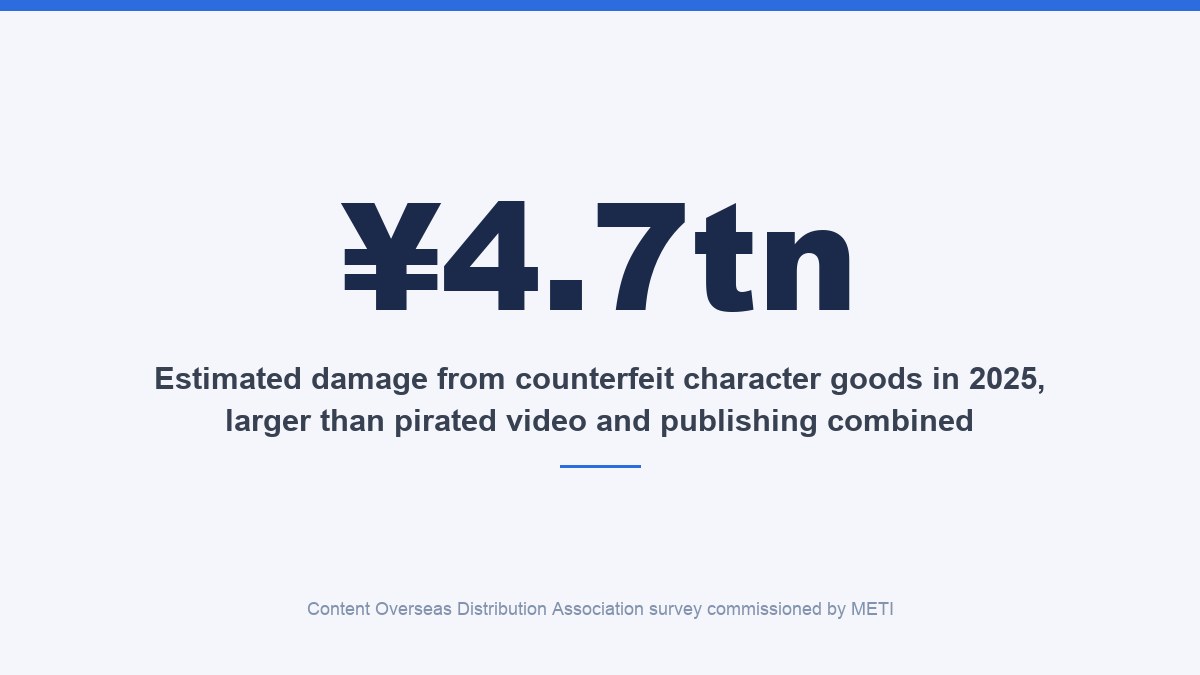
Counterfeit anime merchandise is now a bigger reported problem than anime piracy. A survey by the Content Overseas Distribution Association, commissioned by Japan’s Ministry of Economy, Trade and Industry, put the damage from fake character goods at 4.7 trillion yen in 2025, which was more than the entire figure for pirated video and published content put together.
Bootlegs also sit in a different legal space from most things this site covers, because they involve trademark as well as copyright, and because the rules changed significantly in Japan in 2022. General information, not legal advice.
A bootleg infringes two or three rights at once
A counterfeit figure of an anime character typically infringes the copyright in the character design, because the sculpt reproduces a protected artistic work. If it carries the series logo, the studio name or the licensor’s branding, it also infringes trademarks. If the original product has a registered design, that is a third right.
The distinction matters because the rights behave differently. Copyright arises automatically and lasts a long time. Trademarks must be registered and renewed, but they last indefinitely while they are used, and owners are expected to police them actively or risk weakening them. That is why a company will sometimes ignore fan art for years and then move quickly against a product carrying its logo.
There is a fourth category worth separating out. A figure made in the same factory as the licensed product, outside the authorised production run, is a grey market good rather than a fake. It is physically identical and still unlawful to sell, which is why it is the hardest category for a buyer to detect.
Japan closed the personal import loophole in 2022
Until recently, Japanese law treated importing a counterfeit item for your own use as outside infringement. That meant customs could not seize a fake posted from an overseas seller to an individual, and overseas sellers built businesses on exactly that gap, shipping single items by mail to Japanese buyers.
Amendments to the Trademark Act, the Design Act and the Customs Act took effect on 1 October 2022. Where an overseas business sends goods that infringe a trademark or design right to a person in Japan, that now counts as infringement from the point the goods arrive, whether or not the recipient intended to sell them. Japan Customs can confiscate them.
Before October 2022: a fake ordered for personal use could not be seized at the border.
After October 2022: it can. The infringing act is attributed to the overseas seller, but the practical consequence falls on the buyer, who loses the goods and the money.
The United States handles it differently
American customs rules include a narrow personal use exemption. A traveller arriving in the United States may generally bring in one article of each type bearing a counterfeit mark, for personal use and not for sale, no more than once every thirty days. If the item is sold within a year of import, it or its value is forfeit.
Two limits make this much less useful for anime merchandise than it sounds. The exemption is framed around marks recorded by United States owners, and anime trademarks are usually held by Japanese companies. And it applies to goods accompanying an arriving traveller, not to parcels ordered online, which is how almost all bootleg anime merchandise reaches buyers. Mail order counterfeits are seized.
How to tell before you buy
Japanese licensed merchandise is unusually easy to verify, because the licensing system leaves marks on the product.
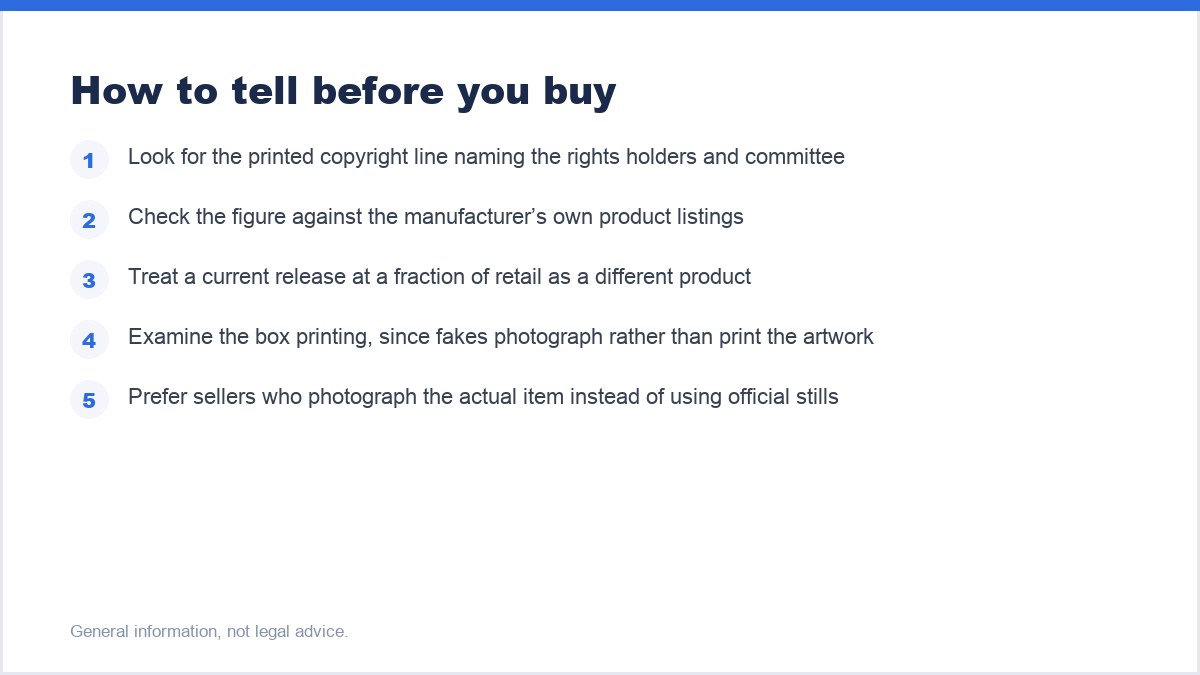
- Look for the copyright line. Licensed goods carry a copyright notice naming the rights holders and often the production committee, printed on the box and frequently moulded into the base. Fakes copy it badly, misspell it, or leave it off.
- Check the manufacturer against the licensor. Good Smile Company, Bandai Spirits, Kotobukiya, Alter and the other established makers all publish their product lines. A figure that exists on a marketplace but not on the manufacturer’s own site is not a rare variant.
- Price is the loudest signal. Scale figures are expensive because they are produced in limited runs. A current release at a fraction of retail is not a bargain, it is a different product.
- Look at the printing, not the sculpt. Counterfeit boxes are usually photographed rather than printed from the original files, so colours shift, text softens and gradients band.
- Be wary of stock images. Official promotional photographs on a listing tell you nothing about what will arrive. Sellers with their own photographs of the actual item are a better sign.
- Authentication seals exist. Several Japanese manufacturers apply holographic licensing stickers, and some now include verification codes.
What happens if you are the buyer
In most countries, buying a counterfeit item for personal use is not a criminal offence for the buyer. The exposure is practical rather than legal. The parcel can be seized at the border and destroyed, you lose what you paid, and the seller is beyond the reach of any realistic complaint. Marketplace buyer protection is sometimes the only recourse, and it works best when you report the listing as counterfeit rather than merely as misdescribed.
Selling is where personal liability becomes real, and that includes reselling a fake you bought in good faith. If you discover a figure is counterfeit, passing it on makes you the infringer rather than the victim.
The wider point is that counterfeit merchandise is the one category where the industry’s complaints about fan activity are unambiguously about money going somewhere else. Unlike fan art, it is a direct substitute for a licensed product made by the people who own the rights, and the companies behind it have no relationship with the fandom at all.