

Almost every anime fan has drawn fan art, commissioned it, or bought a print of it at a convention. Most people assume it sits in a legal grey area. That is roughly right, but the grey is far more structured than it looks. Japan and the United States arrive at a similar practical outcome by completely different routes, and knowing which route applies to you changes what you can safely do.
What follows is general information about how copyright works in those two countries. It is not legal advice, and it does not cover every jurisdiction.
Fan art is a derivative work, and that is the whole problem
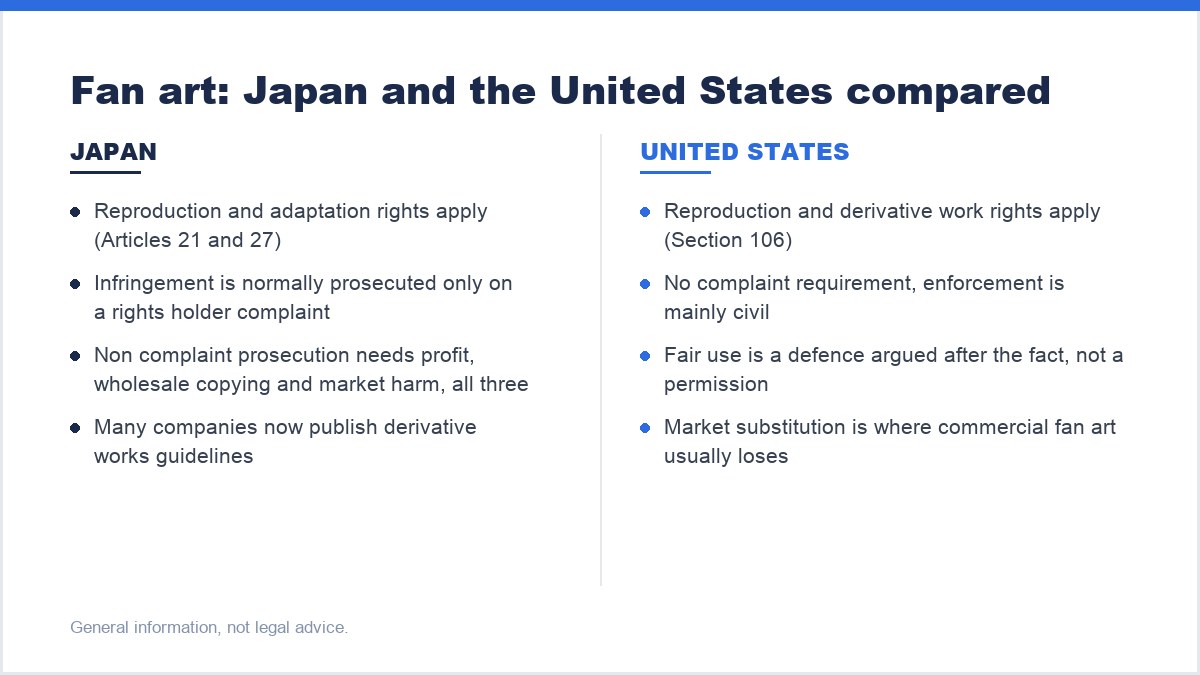
Japan’s Copyright Act gives an author the right of reproduction under Article 21 and the right of adaptation under Article 27. Article 28 then hands the original author the same bundle of rights over any derivative work someone else makes from it. A drawing of an existing anime character is, in copyright terms, a reproduction or an adaptation of that character design. Permission is technically required before you draw it, post it, or sell it.
United States law starts in the same place. Section 106 of the Copyright Act reserves to the owner both the right to reproduce the work and the right to prepare derivative works based on it. Redrawing an existing character falls squarely inside that.
So the honest baseline in both countries is that most fan art technically infringes. What differs is everything that happens after the baseline.
Why Comic Market has run for decades anyway
Comic Market, held twice a year at Tokyo Big Sight, brings tens of thousands of self publishing circles together to sell doujinshi, a large share of it built on characters the sellers do not own. It is not hidden. Publishers attend. Professional artists sell there under pen names. The reason this works is that Japanese copyright infringement has traditionally been a shinkokuzai, an offence prosecutors can only charge once the rights holder files a complaint. No complaint, no case. Most rights holders calculate that an active fan scene sells more volumes and more merchandise than it costs them, so they say nothing.
That arrangement came under pressure when Japan joined the Trans Pacific Partnership and amended its Copyright Act at the end of December 2018 to allow prosecution without a complaint in some cases. The compromise that emerged is narrow on purpose. Charges without a rights holder complaint require all three of the following to be true at once: the work is sold for profit, it reproduces the original wholesale rather than transforming it, and it unreasonably damages the rights holder’s own sales. Ordinary doujinshi and parody fail at least one of those tests, usually the second, so they stayed inside the complaint based system.
Nothing in the law permits fan art. What protects it is that prosecution almost always needs the rights holder to object first, and most of them do not. Protection by tolerance is not the same thing as permission, and tolerance can be withdrawn at any time.
The 1999 Pokemon case showed where the line is
On 13 January 1999 the Kyoto Prefectural Police arrested a doujinshi artist from Fukuoka over a booklet depicting sexual acts between Pokemon characters. Three rights holding companies had filed a complaint eight days earlier. Nintendo’s stated reason for pushing a criminal rather than a civil route was that the depictions could damage the characters’ image and that the mail order distribution put them within reach of children. The artist was held for 22 days and fined. In March that year the printing company in Aichi Prefecture that produced the run was fined 73,000 yen.
It remains the single most cited case in this area because it demonstrated the mechanism rather than changing the law. The complaint system worked exactly as written. Once a rights holder decided to object, the tolerance that protects everyone else evaporated for one person. The lesson most Japanese fan communities took from it was about subject matter and about visibility, not about volume.

Rights holders now publish their own rules
The more useful development of the last few years is that companies stopped relying on silence and started writing the rules down. Cover Corporation publishes derivative works guidelines for its hololive talents. ANYCOLOR publishes guidelines for its own. Capcom published a set in November 2025. Nintendo, Type Moon and a long list of others have their own.
The documents differ in detail but converge on the same shape. Fan and hobby scale creation is fine and needs no individual permission. Selling at small volume as a hobby is usually fine. Operating as a business, selling at commercial scale, registering trademarks, or producing anything the company considers damaging to the brand is not. Several explicitly prohibit corporate entities from relying on the guidelines at all.
If a franchise you draw has published guidelines, those guidelines are the answer for that franchise, and they override general reasoning about what is probably acceptable. They are also the only way to move from being tolerated to being genuinely permitted.
In the United States it is a fair use question instead
America has no doujinshi tolerance tradition and no complaint requirement. What it has is fair use, set out in Section 107, which asks a court to weigh four factors: the purpose and character of the use, the nature of the original work, how much of the original was taken, and the effect on the market for the original.
Fan art tends to do badly on the third factor, because a character design is largely taken whole, and well on the first factor when the work genuinely comments on, parodies or reinterprets the source rather than just reproducing it in a new pose. The fourth factor is where most commercial fan art loses. A print that a fan buys instead of buying official merchandise is competing with the licensed product, and courts take that seriously.
Fair use is also a defence, not a permission. It is something you argue after being sued, which is why almost no fan artist ever finds out whether theirs would have worked.
Where fan artists actually get into trouble
The pattern is consistent across both legal systems, and it has very little to do with drawing.
- Scale. A few prints at a convention table reads as hobby activity. A print on demand storefront with a hundred designs and paid advertising reads as a business.
- Substituting for official goods. Keyrings, acrylic stands, phone cases and plushies compete directly with licensed merchandise. Original illustrations compete with it far less.
- Logos and trademarks. Using a series logo or title on your product is a trademark problem on top of the copyright one, and trademark owners are obliged to police their marks in a way copyright owners are not.
- Explicit content involving characters coded as minors. This is what moved the Pokemon case from tolerated to prosecuted, and it is still the fastest way to attract a complaint.
- Tracing and reposting. Copying another artist’s fan art is a plain infringement of that artist’s work, and it is the complaint platforms act on most readily.
Commissions sit in an awkward middle. Most rights holder guidelines were written for the person who makes the work, not for a client paying for it, and a commission is a transaction for profit even when the volume is one. Artists who take commissions in volume, or who run a subscription tier built on a single franchise, are closer to the business end of every guideline than they usually realise.
A short checklist before you post or sell
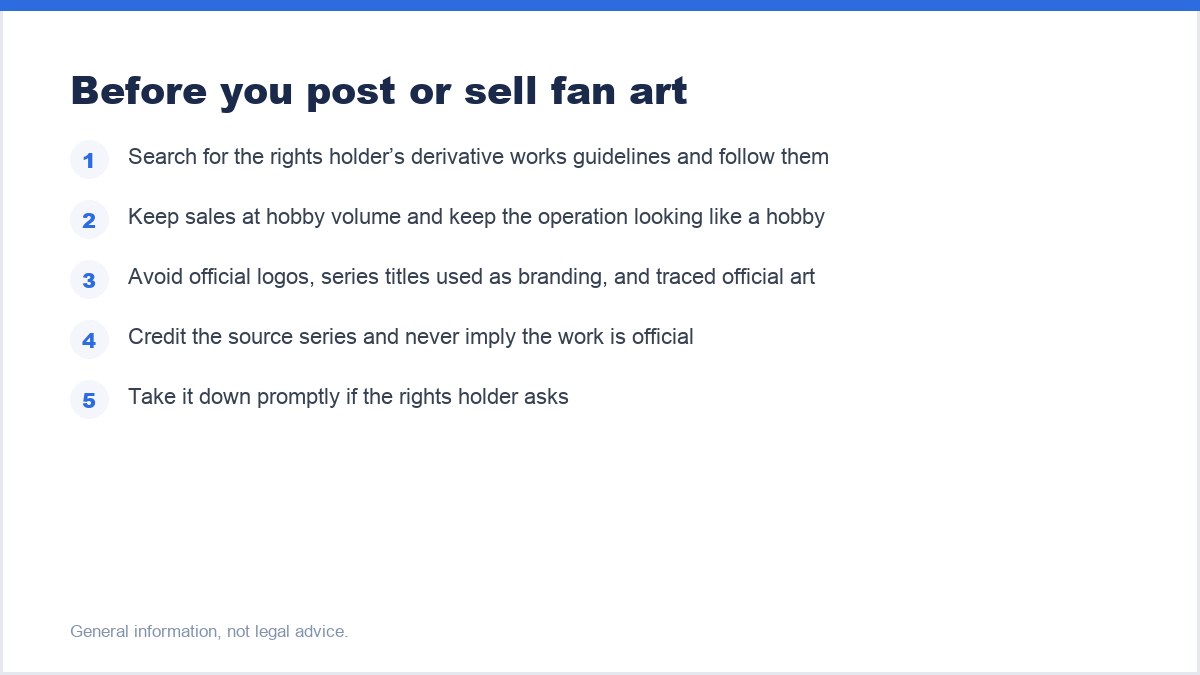
- Search for the rights holder’s derivative works guidelines. If they exist, follow them and stop reasoning from first principles.
- Keep sales at hobby volume and keep the operation looking like a hobby.
- Do not use official logos, titles as branding, or official artwork as a base.
- Credit the source series, and never present the work as official or licensed.
- Take it down promptly if the rights holder asks. A quick removal is usually the end of the matter.
None of that makes fan art lawful. It keeps you inside the space the industry has decided not to enforce against, which in practice is what fan artists have always been relying on.