
Fansubs and scanlations occupy a strange position in anime fandom. They are plainly unlawful, they are also the reason a large share of the Western audience exists at all, and for thirty years rights holders mostly let them run. That arrangement has broken down fast, and the reason is worth understanding properly.
This explains what the law says, why fan translation is treated far more harshly than fan art, and what enforcement has actually done over the last two years. General information, not legal advice.
A translation is a derivative work, and the original author keeps rights in it
Translating a script or a page of manga is an adaptation. Article 27 of Japan’s Copyright Act reserves translation and adaptation to the author, and Article 28 then gives the original author the same rights over the translation that they hold over the original. In the United States, section 106 reserves the preparation of derivative works, and translations are the textbook example.
That has a consequence fan translators often miss. The translation is a work, and the translator may even have authorship in their own expressive choices, but they cannot exploit it. The original author’s rights sit on top. A fansubber cannot license their subtitles, cannot stop others from copying them in any practical sense, and cannot claim the work as theirs in a way that resists the rights holder.
Encoding, hosting and distributing the episode adds the reproduction right and the public transmission right on top. The subtitle file is the smallest part of the exposure. The video is the rest of it.
Why fan translation is treated differently from fan art
Japanese rights holders tolerate an enormous volume of unauthorised fan work. Doujinshi are sold openly at Comic Market. Fan art fills every platform. Fansubs and scanlations get takedowns, criminal complaints and arrests. The difference is not moral and it is not about respect for the source. It is substitution.
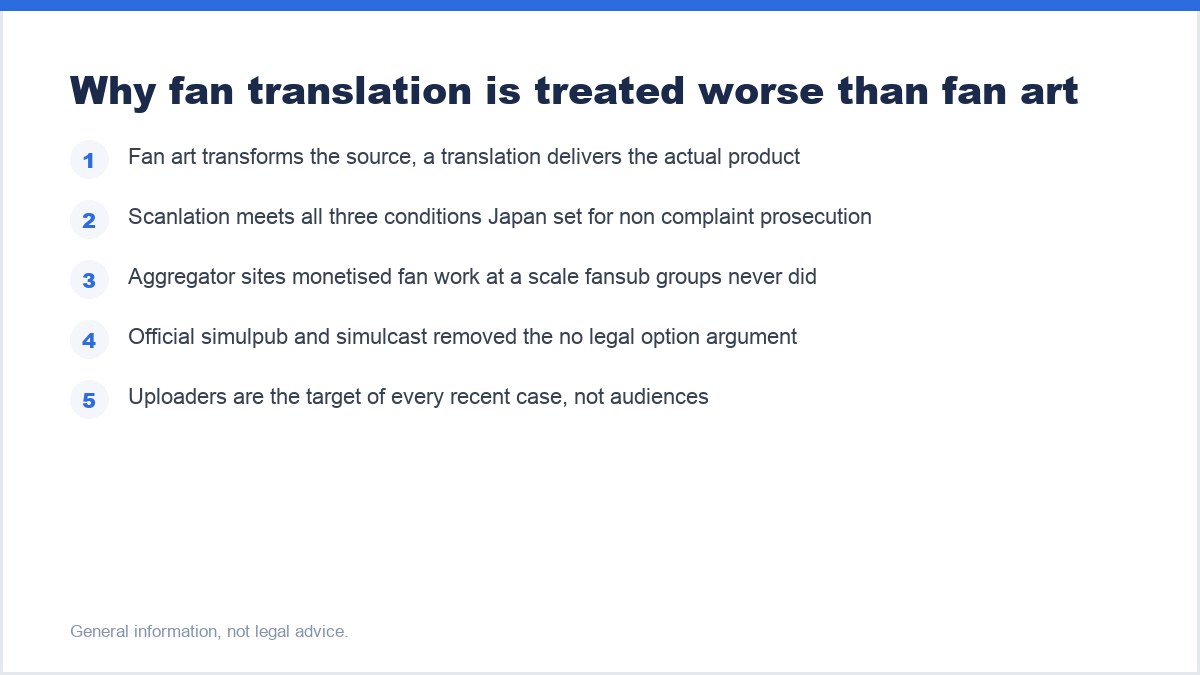
Recall the three conditions Japan built into its 2018 amendment, which allow prosecution without a rights holder complaint only where a use is for profit, reproduces the original wholesale rather than transforming it, and unreasonably damages the rights holder’s sales. Doujinshi fail the second test, because they transform. Fan art fails it too. A scanlation of this week’s chapter passes all three comfortably, because it is the chapter, in full, delivered to the audience that would otherwise have bought it.
Fan art adds something and sells to a different appetite. A fan translation delivers the actual product, free, often before the official release. Rights holders have always drawn the line at substitution, and fan translation is the purest form of it.
The old norms no longer hold
The traditional fansub ethic was that a group dropped a series as soon as it was licensed in their territory, took no money, and distributed nothing that could be bought legally. It was never a legal defence but it was a genuine restraint, and it worked while licensing was slow and patchy.
Two things ended it. Advertising supported aggregator sites took fan translations and monetised them at a scale no fansub group ever did, severing the work from the ethic that produced it. And official simultaneous release arrived. Shueisha’s Manga Plus publishes chapters in English on the Japanese release day for free. Streaming simulcasts cover most of a season within an hour of broadcast in a long list of countries. The argument that no legal option exists is far weaker than it was in 2008, although it is not dead everywhere, which is covered in our piece on region locking.

Enforcement has moved from takedowns to arrests
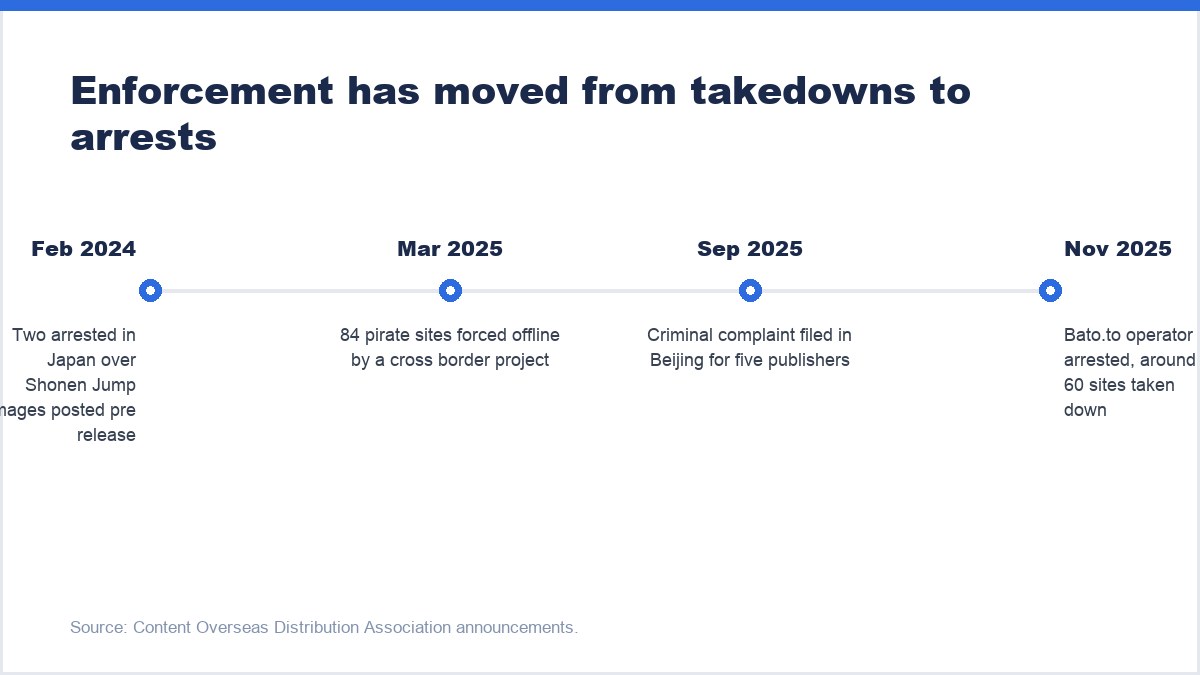
The Content Overseas Distribution Association, the industry body for Japanese rights holders, now runs cross border enforcement with Japan’s Ministry of Economy, Trade and Industry rather than relying on platform takedowns alone. Two cases show the shift.
In February 2024 Japanese police arrested two foreign nationals over images from Weekly Shonen Jump posted online before the magazine went on sale. Kumamoto Prefectural Police released photographs of confiscated materials carrying a scanlation group’s watermark. In the months that followed, most of the major leak and scanlation groups shut down.
In November 2025 the operator behind Bato.to was arrested following a joint investigation by Japanese publishers and Chinese law enforcement, with roughly sixty connected sites taken down alongside it. The association’s Beijing office had filed the criminal complaint that September on behalf of Kadokawa, Kodansha, Shueisha, Shogakukan and Square Enix. The network had been recording hundreds of millions of visits a month.
The association has also reported that a coordinated international project forced 84 pirate sites offline as of March 2025, and it files takedown notices in the hundreds of thousands annually. The strategic change is that complaints are now brought in the jurisdiction where the operator lives rather than where the site is hosted.
What this means for people who read or watch fan translations
- Translating is adapting. There is no version of fan translation that sits outside the author’s exclusive rights, however carefully the group behaves.
- Readers in Japan are exposed in a way readers elsewhere are not. Since 1 January 2021 Japan’s download offence covers manga and written works, as explained in our piece on anime piracy law. Knowledge that the source is illegal is required, and prosecution needs a rights holder complaint.
- Leaks before publication are the most dangerous category of all. They involve physical copies obtained early, they damage a launch directly, and they are the cases that produce arrests.
- Uploaders are the target, not audiences. Every case above concerned people who made the material available.
- Official translation is now genuinely competitive on speed. In many languages it is same day and free, which is the outcome the fansub scene always said it wanted.
There is a reasonable argument that fan translation did real cultural work for decades, opening markets that publishers later monetised. That history is true and it does not change the legal position. What changed is that the industry built the thing fansubs were substituting for, and once it existed the tolerance went with it.