
Cosplay is the one fan activity that almost nobody worries about legally, and on the whole that instinct is correct. Wearing a costume to a convention is about as safe as fan activity gets. The moment money enters, though, the analysis changes, and Japan spent a serious stretch of 2021 arguing about exactly where that line should sit.
Here is what Japanese and United States law actually cover, what the Japanese government concluded, and which parts of cosplay carry real exposure. General information, not legal advice.
Building the costume is the part copyright touches
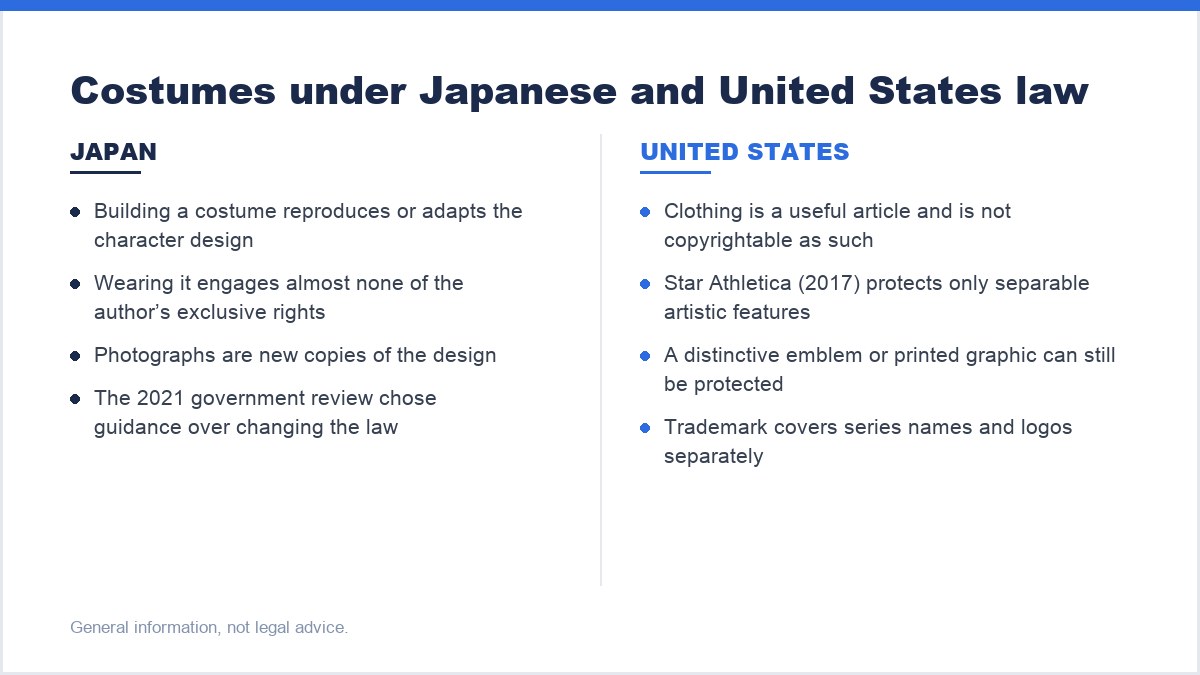
A character design is a protected artistic work. Turning a drawing of it into a physical outfit is, in Japanese terms, a reproduction or an adaptation under Articles 21 and 27 of the Copyright Act, in the same way a drawing of the character would be. The analysis is identical to the one in our piece on anime fan art, and so is the practical outcome: it is technically within the rights holder’s control, and they almost never object.
United States law gets to a friendlier answer by a stranger route. Clothing is a useful article, and useful articles are not copyrightable. In Star Athletica v. Varsity Brands in 2017 the Supreme Court held that a design feature of a useful article can be protected only if it can be perceived as a work of art separate from the article and would qualify as a protectable work on its own. The silhouette, the cut and the construction of a costume are generally unprotected. A distinctive emblem, pattern or printed graphic on it can be a separate matter.
Wearing it is barely a copyright question at all
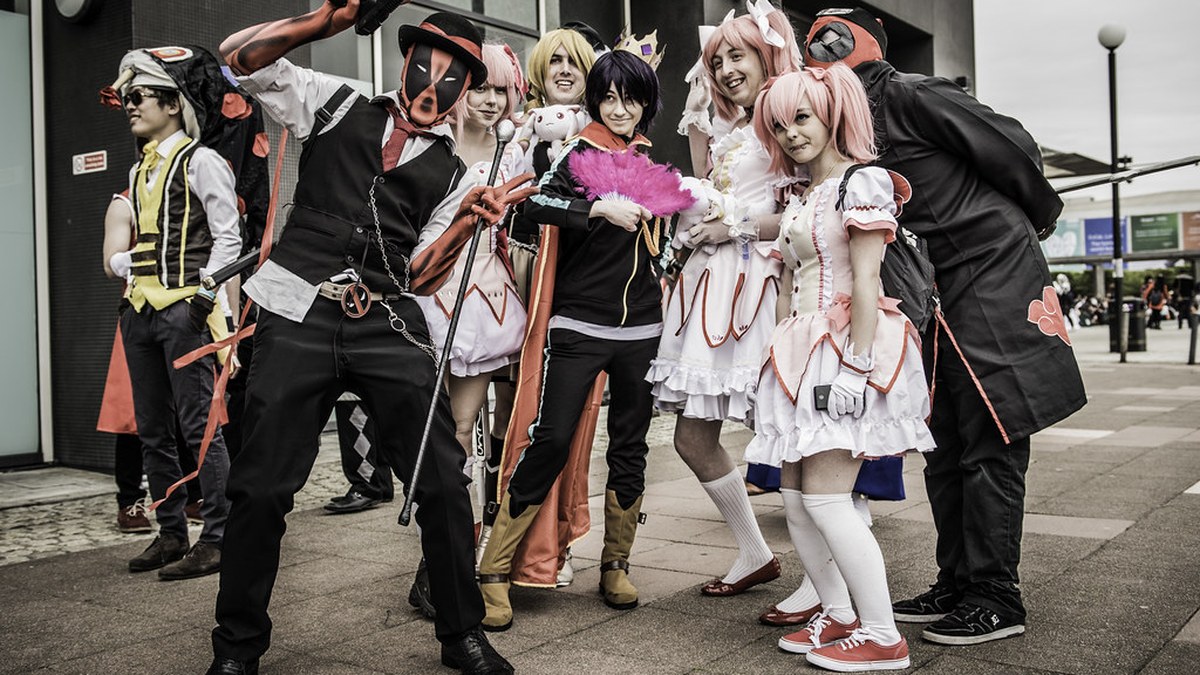
Once the costume exists, walking around in it does not engage most of the rights an author holds. There is no new copy being made and nothing is being transmitted. Japanese law reserves specific acts such as reproduction, adaptation, public transmission and performance, and simply being dressed as a character in public does not fit comfortably into any of them.
Photographs are different, because a photograph of the costume is a new fixed copy of the character design. In practice nobody enforces against convention photos, but it is the reason posting is a slightly more exposed act than wearing.
Unpaid cosplay is tolerated everywhere and challenged nowhere. Cosplay that generates income is where rights holders, and for a while the Japanese government, start paying attention.
What Japan decided in 2021
In January 2021 the Japanese government began looking at whether copyright rules needed clarifying for cosplayers who earn money, through paid appearances, subscription platforms, photo books or selling costumes. Shinji Inoue, the minister responsible for the Cool Japan strategy, said the review would report by the end of the financial year that March. The government took views from rights holders and from cosplayers, including Enako, among the best known professionals in the field.
The outcome was a decision not to change the law. Officials concluded that tightening the rules risked driving people out of cosplay altogether, and that the better approach was to publish worked examples showing when a cosplayer would be expected to seek permission or pay a licence fee. The guidance route was chosen precisely because the hobby side was working and nobody wanted to break it.
That is a useful signal about how Japan handles fan activity generally. The pattern is consistent: leave the amateur layer alone, clarify the commercial layer, and avoid statutory change that would catch both.
Where cosplay actually becomes commercial
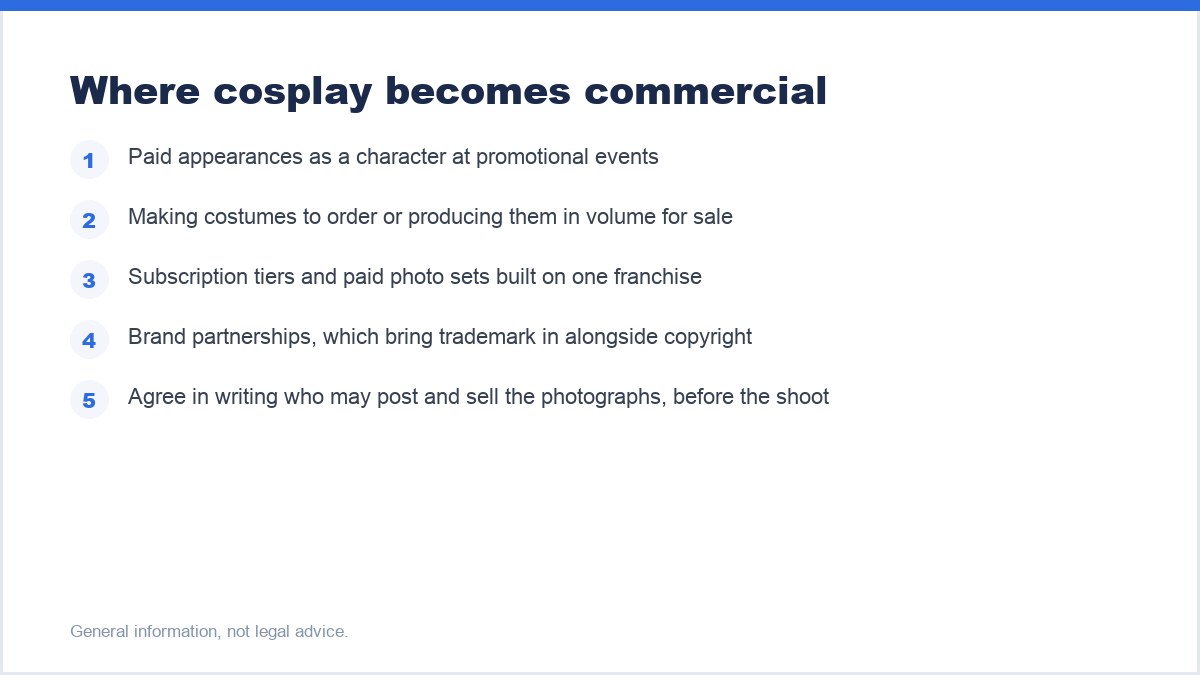
- Paid appearances. Being booked and paid to appear as a character at a promotional event is a commercial use of that character, and it is the clearest case in which a licence would normally be expected.
- Selling costumes. Making costumes to order, or producing them in volume for sale, is manufacturing goods based on someone else’s design. Several rights holder guidelines name this explicitly as outside what they permit.
- Subscription tiers and photo sets. Charging for images of yourself in a copyrighted character design is selling access to a derivative work. Volume and framing matter more than the fact of payment.
- Brand partnerships. Using a character to advertise a third party product brings trademark into play alongside copyright, and trademark owners are obliged to police their marks in a way copyright owners are not.
Several Japanese companies now address cosplay directly in published derivative works guidelines. Cover Corporation revised its rules to cover cosplay, fan organised events and overseas activity. ANYCOLOR draws the same hobby and business line. Where a franchise has published rules, those rules are the answer for that franchise.
Who owns the photograph
This catches cosplayers out more often than copyright does. The photographer owns the copyright in the photograph, not the person in it. A cosplayer who commissions a shoot does not automatically acquire the right to use the images commercially, and a photographer who shoots a cosplayer at a convention does not automatically acquire the right to sell the results.
The cosplayer’s protection comes from a different direction. Japan recognises portrait rights, and the Supreme Court confirmed in 2012 that a person has a commercial interest in the use of their image. The United States protects the same interest through state right of publicity law. Either way, using a recognisable person’s likeness to sell something generally needs their agreement, whatever the photographer’s copyright says.
The practical fix is boring and effective. Agree in writing, before the shoot, who may post, who may sell, and whether either party may license the images on. Most cosplay disputes are about this and not about anime companies at all.
Convention rules are a contract
Event terms about photography, prop weapons, where you may sell and what you may wear are enforceable because you agreed to them when you bought the ticket. They are frequently stricter than the law, and they are the rules you are overwhelmingly most likely to actually run into. Read them.