

In October 2024 twenty six of Japan’s best known voice actors put their names to a campaign called No More Unauthorized Generative AI. Ryūsei Nakao, the voice of Freeza, opened the launch video by saying he had been surprised to find his voice being sold without his permission, and that his voice is his livelihood. Kōichi Yamadera, Yūki Kaji, Daisuke Namikawa, Jun Fukuyama and Romi Park were among those who followed.
The campaign was careful to say it was not opposed to AI. What it objected to was training and distribution without consent. The reason they had to campaign rather than sue is that a voice is one of the hardest things to protect in either Japanese or American law. General information, not legal advice.
Copyright does not protect a voice
This is the first thing to get straight. Copyright protects works. A voice is not a work, it is a characteristic of a person, and no copyright system treats the sound of someone’s speech as something they own.
What is protected is a recorded performance. Japanese law gives performers a set of neighbouring rights over their fixed performances, covering recording, broadcasting and making the performance available online, together with moral rights to be credited and to object to distortion of the performance. United States law protects the sound recording as a work.
Those rights are engaged when someone copies the recordings, which is exactly what training a voice model does. That takes you into the training data analysis set out in our piece on AI anime art and copyright, including Japan’s Article 30-4 exception and the 2024 guidance that removed style imitation from its scope.
The gap opens at the output. A synthetic voice that sounds like a given actor is not a copy of any particular recording. Nothing was reproduced. The thing that was taken is the identity, and copyright has no answer to that.
Training on recordings is a copyright question. The cloned voice itself is a personality and publicity question. Most of the confusion in this area comes from trying to solve the second problem with the first set of rules.
Japan protects identity through personality rights
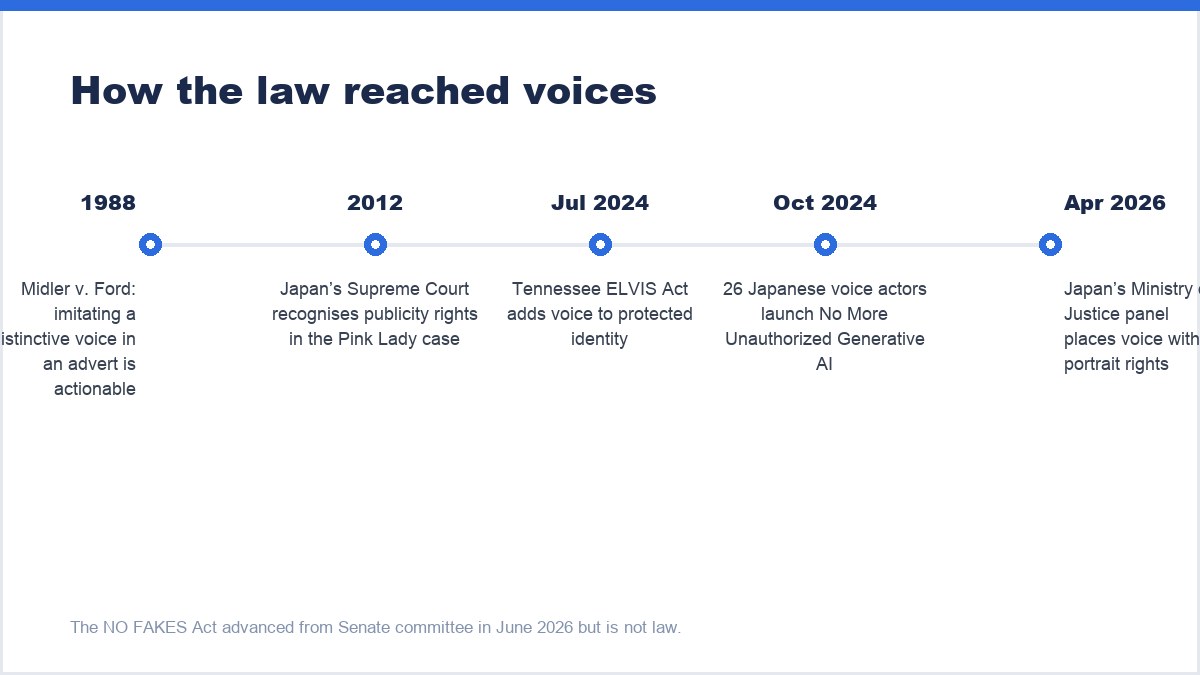
Japan has no statute creating a right of publicity. The courts built one. In February 2012 the Supreme Court confirmed in the Pink Lady case that a person has a legally protected interest in the commercial value of their identity, derived from personality rights, and set a deliberately narrow test. The right is infringed where the use is aimed exclusively at exploiting the person’s power to attract customers, rather than where their name or image appears incidentally in commentary or reporting.
That framework was designed for photographs of celebrities in magazines. Applying it to a synthetic voice is new ground, which is why the voice actors campaigned instead of litigating. A test built around whether a use exploits customer attracting power is awkward when the use is a hobbyist posting cloned audio for free.
Japan started closing that gap in 2026. On 25 April an expert panel convened by the Ministry of Justice met for the first time and concluded that voice rights belong in the same legal category as portrait rights and publicity rights. No concrete protections were agreed at that meeting. State Minister Hidehiro Mitani said that the burden of establishing the scope of protection through litigation was too great to place on voice actors, which is as clear a statement as a government gives that the existing law is not doing the job.
The United States has been here before, without AI
American courts dealt with voice imitation decades ago. In Midler v. Ford Motor Company in 1988 the Ninth Circuit held that deliberately imitating Bette Midler’s voice in a commercial, after she declined to perform, was actionable. In Waits v. Frito-Lay in 1992 the same court upheld a substantial award to Tom Waits on similar facts.
Those cases establish the principle that a distinctive voice, deliberately imitated to trade on the performer’s identity, is protected. They do it through state right of publicity law and unfair competition rather than copyright, which means the answer varies from state to state and there is no federal baseline.
Legislatures have started filling that in. Tennessee’s ELVIS Act, which took effect on 1 July 2024, added voice explicitly to the protected attributes of identity in that state. At federal level the NO FAKES Act, which would create a national right to control digital replicas of a person’s voice and likeness, was advanced unanimously by the Senate Judiciary Committee on 18 June 2026 and placed on the Senate calendar that July. It has not been enacted.
Why anime is an unusually exposed case
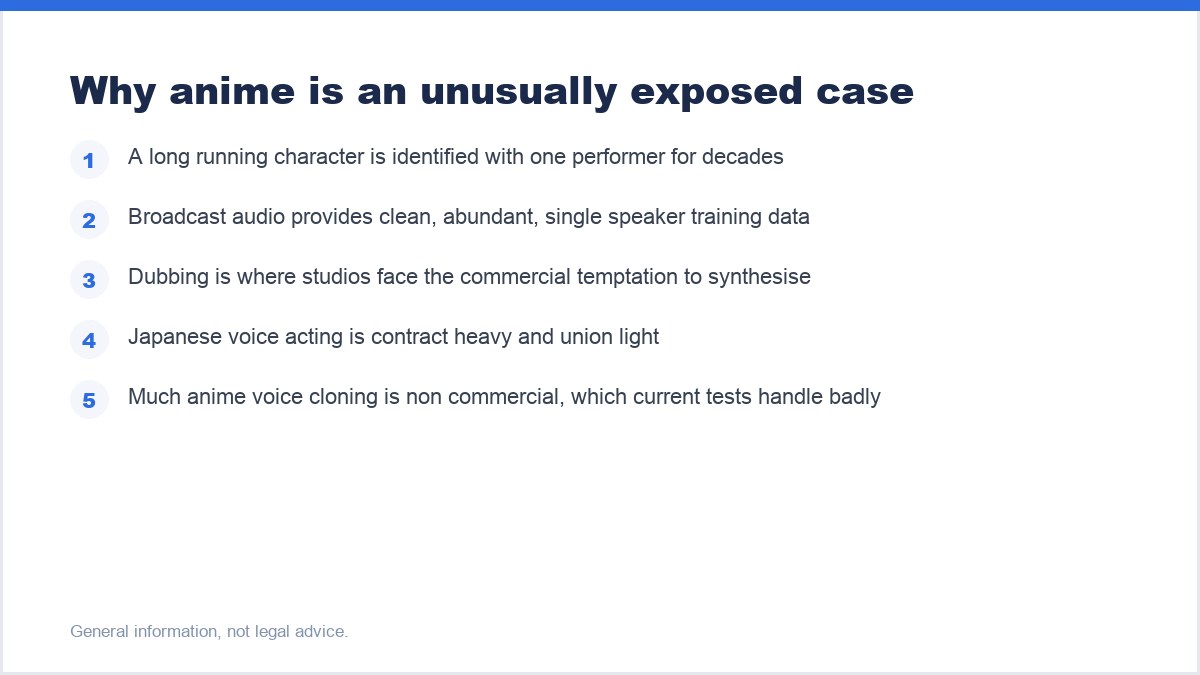
- Voices are the brand. A long running character is identified with one performer across decades, which makes the imitation both easier to do and more obviously an appropriation.
- The training data is clean, abundant and labelled. Decades of broadcast audio exist with a single speaker per character, which is close to an ideal dataset.
- Dubbing is the commercial pressure point. Localisation into many languages is expensive and slow, and synthetic voices are being offered as the solution. That is where studios face the real temptation, and where performers face the real loss.
- Japanese voice acting is contract heavy and union light. American performers negotiated AI terms collectively. Japanese performers largely have not, which is part of why a public campaign was the available tool.
- Fan use blurs the picture. A great deal of anime voice cloning is non commercial fan work, which sits badly with a legal test built around commercial exploitation.
Where this leaves things
For performers, the strongest protection today is contractual rather than statutory. Consent clauses covering synthetic reproduction, limits on what recordings may be used for, and explicit refusal of training rights do more than any current cause of action, because they create a straightforward breach claim instead of requiring a novel one.
For anyone making or posting cloned anime voices, the position is roughly this. Non commercial fan use currently sits in a space the law was not designed for and has not yet reached, which is not the same thing as being permitted. Commercial use trading on a recognisable performer’s identity is already actionable in the United States and is reachable through personality rights in Japan. And the direction of travel in both countries is clearly towards more protection, not less.
The voice actors’ own framing is the sensible one. The objection is not to the technology. It is to a dataset being assembled, and a product being sold, from someone’s work without asking them first.