
Anime is the single most imitated visual style in generative image models, which has made it the sharpest test case for AI and copyright anywhere. Two questions get tangled together constantly: whether it was lawful to train a model on anime artwork, and whether the picture that comes out the other end belongs to anyone. They have different answers, and in Japan and the United States those answers are not the same.
This is general information about how the law currently stands, not legal advice, and the position is still moving.
Japan allows training far more broadly than most people realise
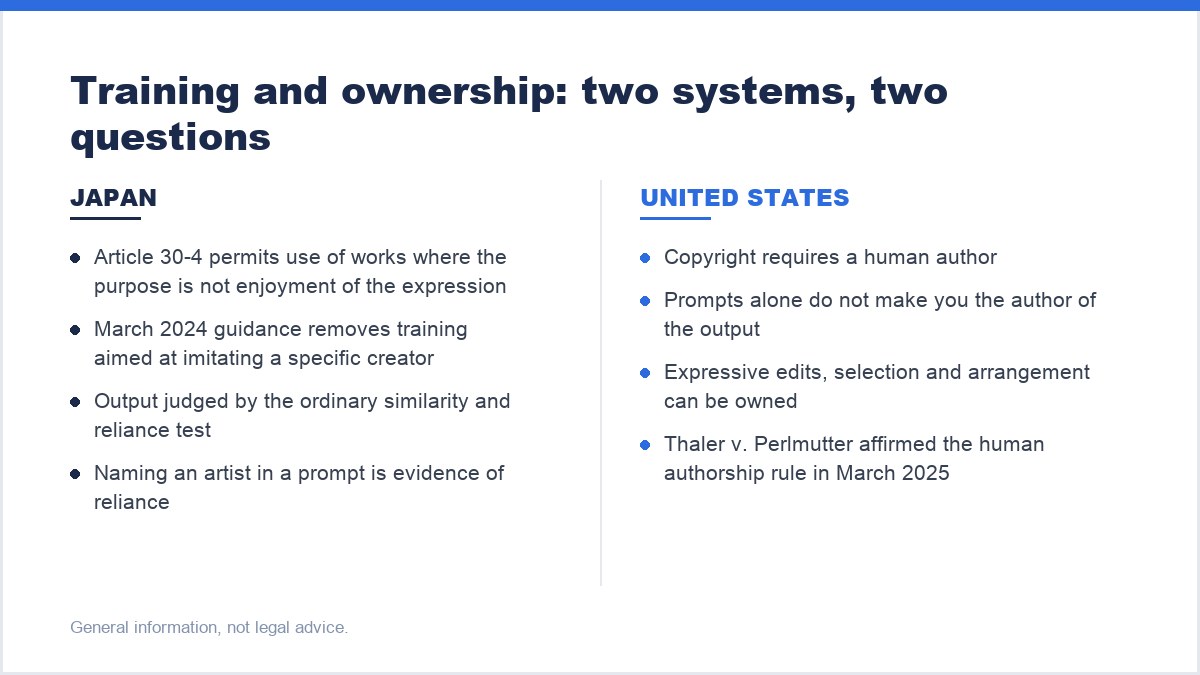
Article 30-4 of Japan’s Copyright Act, added in 2018, permits using a copyrighted work when the purpose is not to enjoy the expression in it. Machine learning is the headline example. The provision does not distinguish between research and commercial use, which is why Japan acquired a reputation as the most permissive major jurisdiction for AI training data.
That reputation is now out of date, and the correction came from the Japanese government itself. On 15 March 2024 the Agency for Cultural Affairs published a General Understanding on AI and Copyright, produced by the Legal Subcommittee of the Council for Cultural Affairs. It does not change the statute. It sets out when the exception stops applying.
Two limits do most of the work. First, Article 30-4 falls away when the purpose includes enjoyment of the expression. The document gives as an example gathering works specifically in order to generate output resembling them, which is precisely what fine tuning a model on one artist or one studio does. Second, the exception does not cover uses that unreasonably prejudice the rights holder’s interests, and it names the case of scraping a database work when licences for that exact kind of data analysis are already sold in the market.
General purpose training on a broad corpus still sits comfortably inside Article 30-4. Deliberately training on one creator’s work so the model can reproduce that creator’s look is now officially outside it. The style imitation case is the one Japan singled out.
The output is judged like any other picture
Japanese law treats an AI generated image at the output stage no differently from one a person drew. The test is the ordinary infringement test: is the output similar to a protected work, and was it produced in reliance on that work. Similarity alone is not enough, and independent creation is a genuine defence.
The complication with generative models is reliance. If you typed a character’s name, or an artist’s name, into the prompt, that is evidence you relied on their work. If the model was trained on the work and you asked for something in its direction, reliance becomes harder to argue away. The Agency’s document is explicit that a user who prompts for output resembling a specific existing work can be liable even though the model did the drawing.
Style itself is a different matter. Copyright protects expression, not style, in Japan and in the United States alike. An image that merely looks like a given studio’s house look, without reproducing any particular design, drawing or composition, is generally not infringing. The exposure appears when a recognisable character appears, or when a specific illustration is close enough to be a reproduction of it.
The United States asks who, if anyone, is the author
On 29 January 2025 the United States Copyright Office published the second part of its report on copyright and artificial intelligence, dealing with copyrightability. Its conclusion is that copyright protects original expression created by a human, and that it does not extend to parts of a work where no human controlled the expressive elements.
The Office drew the line at prompting. Writing a prompt, however long and however many times you revise it, does not make you the author of what the model returns, because you do not control the expressive detail of the result. What a human can own is the part they actually made: expressive modifications to an AI output, the selection and arrangement of AI generated elements, and any human authored material combined with them. That mirrors the earlier Zarya of the Dawn decision, where a comic was registered for its text and its arrangement but not for the images themselves.
Courts have backed the underlying principle. On 18 March 2025 the DC Circuit affirmed in Thaler v. Perlmutter that the Copyright Act requires a human author, in a case where the applicant had named his own machine as sole author. The court was careful to add that this does not stop works made with the assistance of artificial intelligence from being protected. It stops the machine being the author. The Supreme Court declined to take the case.
What that means if you post AI anime art
The gap between the two systems produces a result that surprises people. An AI generated anime illustration can be lawful to produce and still belong to nobody. You can publish it, and someone else can copy it, and in the United States you will have very little to say about that unless your own contribution went well beyond the prompt.
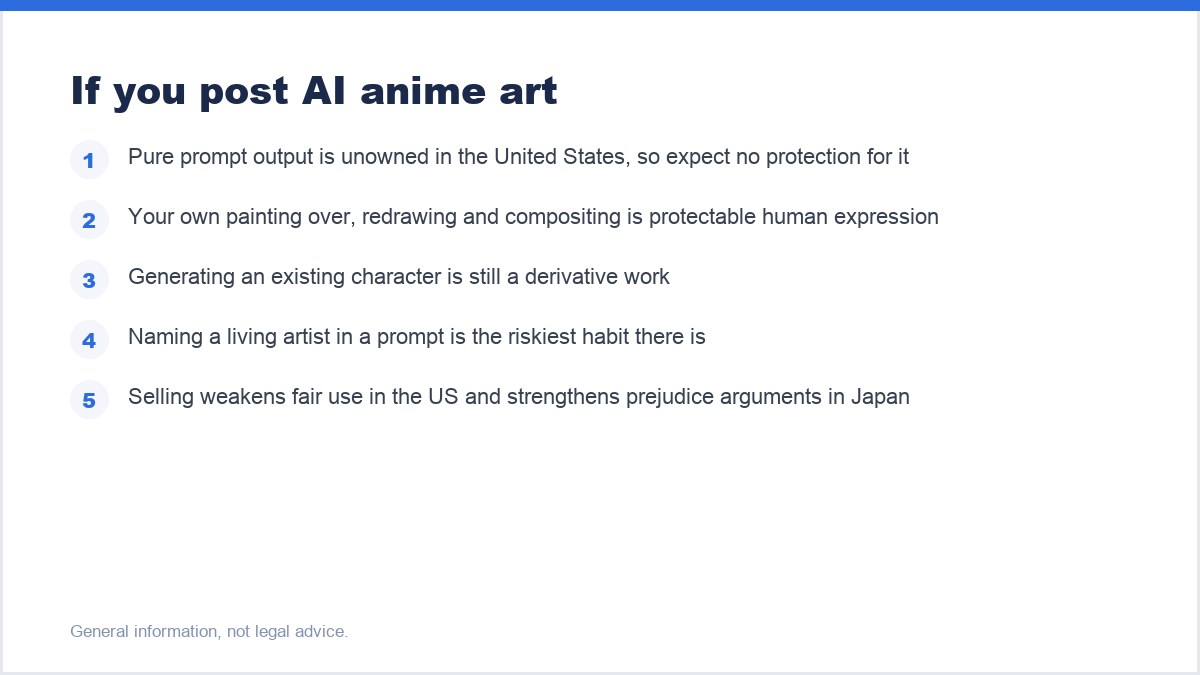
- Pure prompt output is unowned in the United States. Register nothing and expect no protection for the generated image itself.
- Your edits are yours. Painting over, redrawing, compositing and substantially reworking an output creates human expression that can be protected, and the registration should disclose the AI generated material it sits on.
- Named characters are still characters. Generating an existing anime character does not stop being a derivative work because software drew it. The analysis in our piece on anime fan art applies in full.
- Naming a living artist in a prompt is the riskiest habit. It is the clearest available evidence of reliance, and in Japan it is the fact pattern the Agency for Cultural Affairs chose to flag.
- Selling changes the calculation. Commercial use weakens a fair use argument in the United States and strengthens the prejudice argument in Japan.
Where this is heading
Neither government has proposed a new right for AI outputs. The United States Copyright Office specifically recommended no new legislation in its January 2025 report, taking the view that existing principles can handle the question. Japan has chosen guidance over amendment for now, which keeps Article 30-4 intact while narrowing how far anyone can lean on it.
The practical pressure is coming from elsewhere. Platforms have started requiring AI disclosure, commission marketplaces have written their own rules, and Japanese rights holders have begun naming AI output in the derivative works guidelines they publish for fans. For most people posting anime art, those private rules will bite long before copyright law does.