
Anime piracy law is one of the most confidently misreported subjects in the fandom. The single most repeated claim, that Japan made downloading anime illegal in 2021, is wrong in a specific and interesting way. Japan criminalised downloading anime nearly a decade earlier. What changed in 2021 was manga.
Below is what the law in Japan and the United States actually says, what the penalties are, and what the enforcement picture looks like now. This is general information rather than legal advice.
Japan draws its main line between uploading and downloading
Uploading a copyrighted work without permission has long been the serious offence in Japan. It carries up to ten years in prison, a fine of up to ten million yen, or both, and for a company the corporate fine runs far higher. That applies to the person who rips an episode and puts it online, to the operator of the site hosting it, and in principle to anyone seeding it.
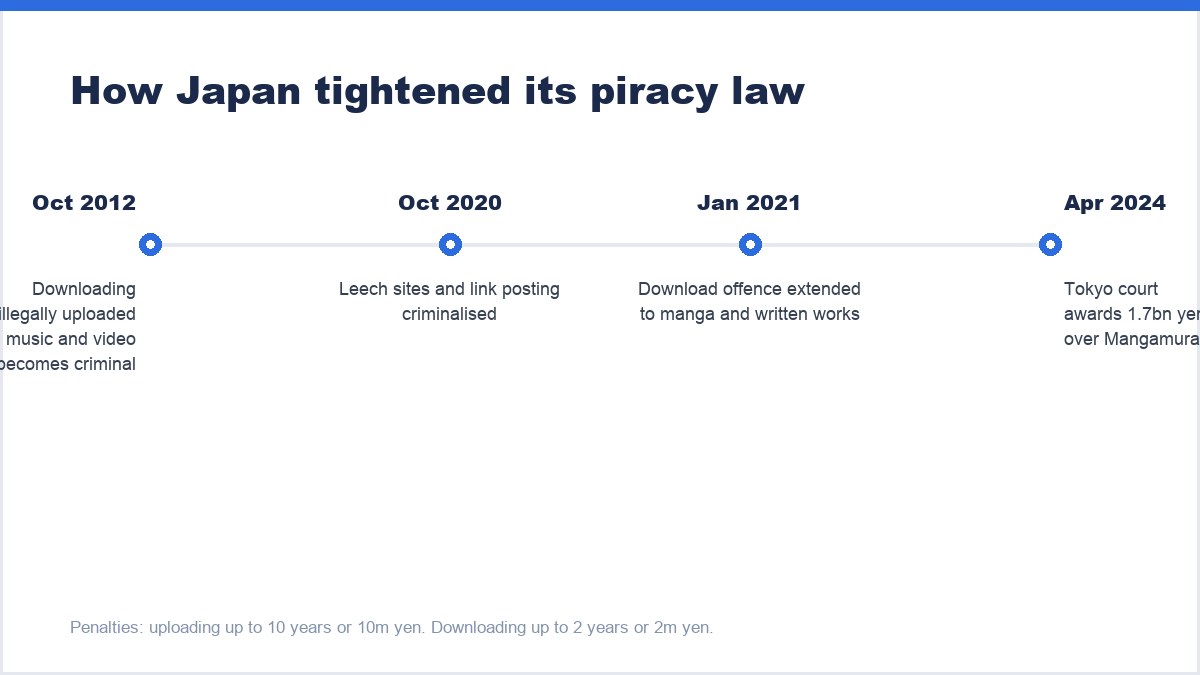
Downloading was treated differently until October 2012. An amendment that took effect that month made it a crime to knowingly download music or video that had been uploaded illegally, punishable by up to two years in prison, a fine of up to two million yen, or both. Anime episodes are video, so anime downloading has been criminal in Japan since 2012.
The 2021 change people remember was the extension of that same download offence beyond music and video to every other category of copyrighted work. From 1 January 2021 it also covers manga, magazines, novels and academic papers. The penalty is the same two years and two million yen. The target was scanlation and manga aggregator sites, not anime.
October 2012: downloading illegally uploaded music and video, including anime, becomes criminal in Japan.
1 January 2021: the same offence is extended to manga, magazines and written works.
Both carry up to two years and up to two million yen. Uploading carries up to ten years and up to ten million yen.
The 2021 law has deliberate escape valves
Japanese lawmakers were warned that a blanket download ban on all written works would criminalise ordinary browsing and chill fan activity, so the final text carries several exemptions. Downloading a few frames of a long manga is excluded. So is a copyrighted work that appears incidentally, such as a poster in the background of a photograph. Derivative works and parody, which is to say the doujinshi scene, are excluded. There is also a general carve out for cases the law treats as minor.
Two further limits matter in practice. The offence requires knowledge that the source was illegally uploaded, so an accidental download from a site you reasonably believed was licensed is not caught. And like most Japanese copyright offences it is complaint based, meaning prosecutors need the rights holder to file before they can charge. Criminal penalties for repeated, knowing downloading of whole works were also reserved for exactly that: repeated and at scale.
Streaming is handled separately, and so are the sites that link
Watching a stream is not downloading. A browser’s temporary cache is excluded from the Japanese download offence, which means that someone who only ever watches episodes on a pirate streaming site is not committing the download crime. That gap is a large part of why pirate streaming grew while pirate downloading shrank.
Japan closed a related gap on 1 October 2020 by criminalising leech sites, meaning sites and apps whose purpose is to collect links to infringing material rather than host it themselves. Operating one carries up to five years and up to five million yen. Posting links on one carries up to three years and up to three million yen. The law deliberately reaches the people who make pirated material findable, which is where the real traffic bottleneck sits.
Mangamura is the case that shaped all of this
Mangamura launched in 2016 and became the largest manga piracy site in the world, drawing something on the order of one hundred million visits a month at its peak. It went dark in April 2018. Japanese publishers put the damage at roughly 320 billion yen.
Its operator, Romi Hoshino, was sentenced by the Fukuoka District Court in June 2021 to three years in prison, a ten million yen fine, and a further sixty two million yen penalty. On 18 April 2024 the Tokyo District Court ordered him to pay 1.7 billion yen in damages to Kadokawa, Shogakukan and Shueisha, described by the court as a record for a piracy case in Japan. He said publicly that he had no intention of paying.
Mangamura is the reason the 2020 leech site provisions and the 2021 download extension exist at all. Almost every tightening of Japanese copyright law in the last eight years traces back to it.
What the numbers look like now
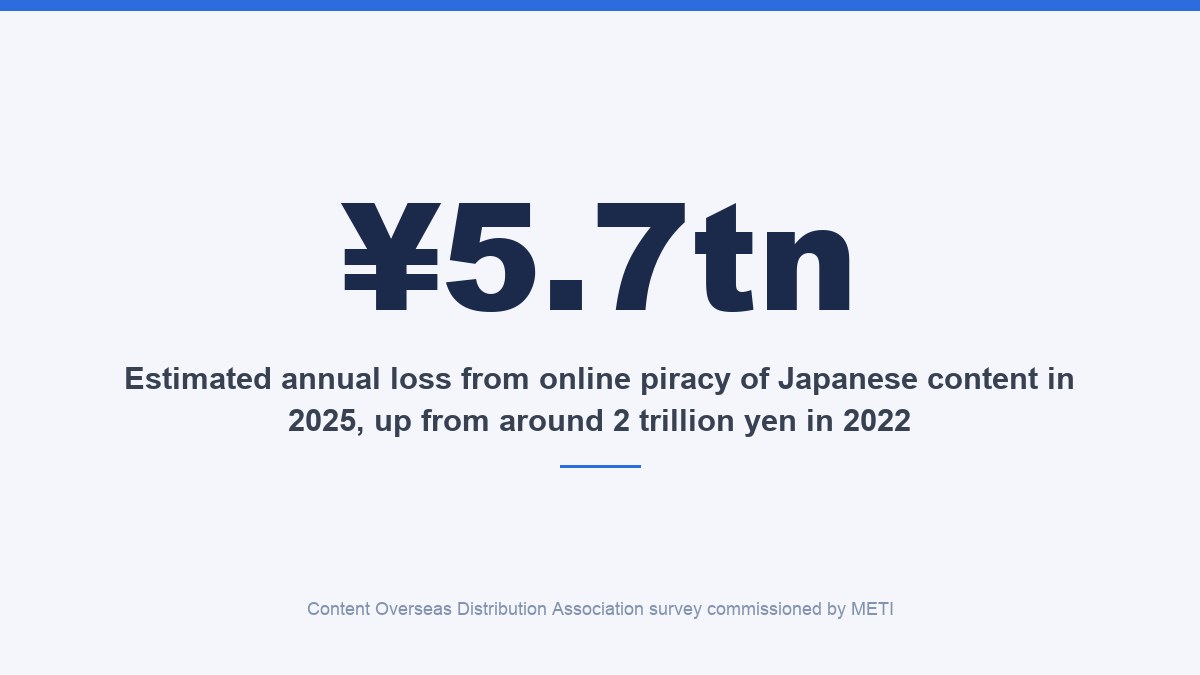
A survey by the Content Overseas Distribution Association, commissioned by Japan’s Ministry of Economy, Trade and Industry and published in 2025, put the annual loss from online piracy of Japanese content at about 5.7 trillion yen. The comparable 2022 figure was around 2 trillion. Published content accounted for 2.6 trillion, up from 0.8 trillion, and video for 2.3 trillion, up from 0.9 trillion. Adding counterfeit character merchandise, which the earlier study did not measure, takes the total to 10.4 trillion yen.
Those are modelled estimates built from consumer surveys in Japan, China, Vietnam, France, the United States and Brazil, and like all piracy loss figures they assume a pirated view would otherwise have been a paid one. Treat them as a measure of scale and trend rather than of money that would certainly have been earned. The trend itself is not seriously disputed, and it tracks the global growth of anime as much as it tracks any failure of enforcement.
Enforcement has moved with it. The association reported that a coordinated international project had forced 84 pirate sites offline as of March 2025, and it files takedown notices in the hundreds of thousands annually, with compliance rates above ninety percent on the larger social platforms.
The United States works the other way round
American law has never criminalised ordinary downloading by an individual viewer. Copyright infringement is primarily a civil matter there, and rights holders enforce it by suing, by sending notices to internet providers, or by having material taken down under the notice and takedown procedure in section 512 of the Copyright Act. Statutory damages can be large, up to 150,000 dollars per work for wilful infringement, which is what makes civil suits credible without any criminal element.
Criminal copyright liability in the United States generally requires wilful infringement for commercial advantage or private financial gain, or reproduction and distribution at a defined scale. The Protecting Lawful Streaming Act, which became law at the end of 2020, added a felony offence for running a commercial, for profit service that streams infringing works. It was written specifically to reach the operators of illegal streaming businesses and it does not apply to the individual who watches.
So the practical difference is this. In Japan a viewer who knowingly downloads can in theory be charged. In the United States a viewer is exposed to a lawsuit rather than a prosecution. In both countries the people actually taken to court are overwhelmingly operators and uploaders, not audiences.
What this means if you watch anime
- Downloading anime in Japan has been a criminal offence since 2012, not since 2021, and it needs knowledge that the source was illegal.
- Uploading is the serious offence everywhere, and the gap between the two penalties is deliberate.
- Streaming sits outside Japan’s download offence, which is why the leech site provisions were added instead.
- Running or monetising a piracy site is where real prison sentences and record damages awards happen.
- Licensed availability keeps widening, and a lot of what drove piracy historically was that no legal option existed in a given country. That is a licensing problem, which is covered in our piece on why anime is region locked.