

Ask who owns a given anime and most people name the studio. It is the name on the show, the name fans follow, and the name that gets credited for a good season. It is also, in the great majority of cases, the wrong answer.
The right answer is usually a committee of companies that exists only for that one title, that holds the rights in slices, and that the studio may not even be a member of. Understanding it explains a surprising amount about the industry, from why licensing takes so long to why a studio can animate a worldwide hit and still be short of money. What follows is general information, not legal advice.
The production committee, and the kanji that gives it away
Most anime is financed through a seisaku iinkai, a production committee. It is a joint venture formed for a single work. Several companies put in money, and in return each takes the rights to exploit the title in a particular way. A typical committee might include the publisher of the original manga or light novel, a television broadcaster, a music label, a home video label, a merchandise or toy company, and an advertising agency.
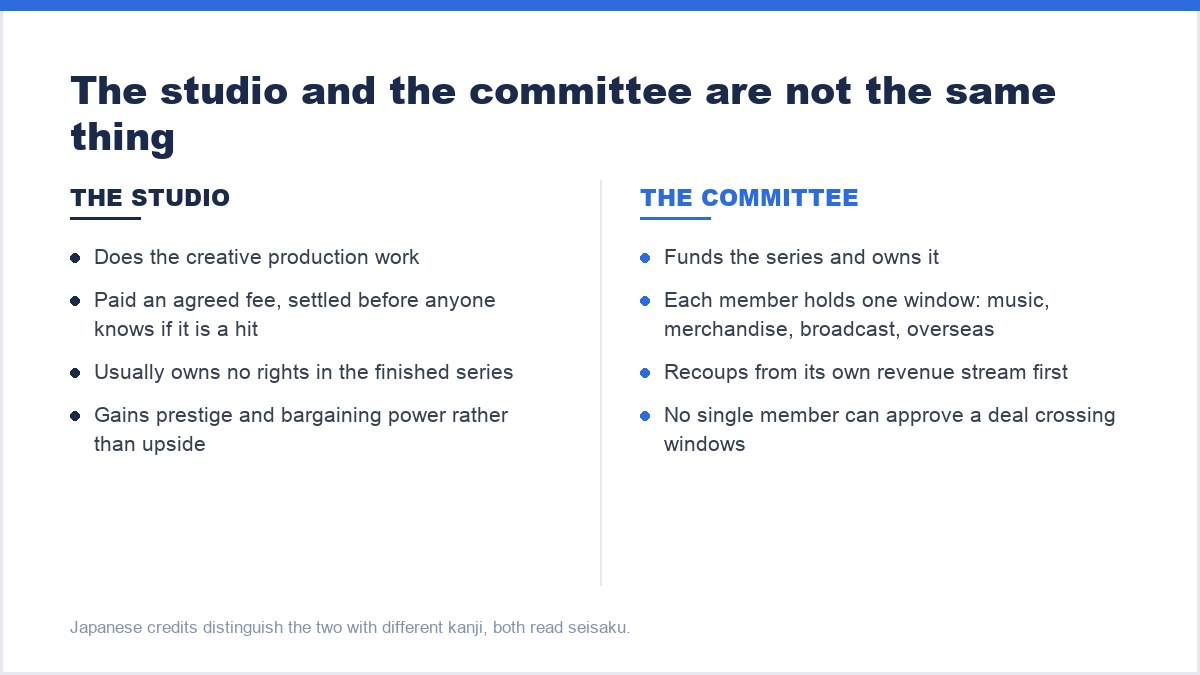
Japanese credits actually tell you this, if you know where to look. Two different words are both read seisaku. One is written with the kanji for manufacture and is used for the committee that funds and owns the work. The other is written differently and refers to the creative production itself, which is the studio. When a credit roll lists a studio next to one and a committee next to the other, it is distinguishing the company that made the show from the companies that own it.
The committee is generally organised as a partnership under Japanese law rather than as a corporation. That keeps it cheap to form, keeps the accounting inside each member company, and means it quietly stops existing once the title stops earning.

Rights are split by window, not shared
The crucial feature is that committee members do not jointly own everything. Each right has a window company, the single member responsible for licensing that right and collecting on it. The music label handles soundtrack and song rights. The toy company handles merchandise. The broadcaster handles domestic television. A distributor handles overseas sales.
Each member recoups from its own stream first and shares in the pot afterwards, which aligns the incentives but also means no single member can approve a deal that crosses windows. An overseas streaming offer has to clear the distribution window holder, and if the deal touches music or merchandise it has to clear those holders too.
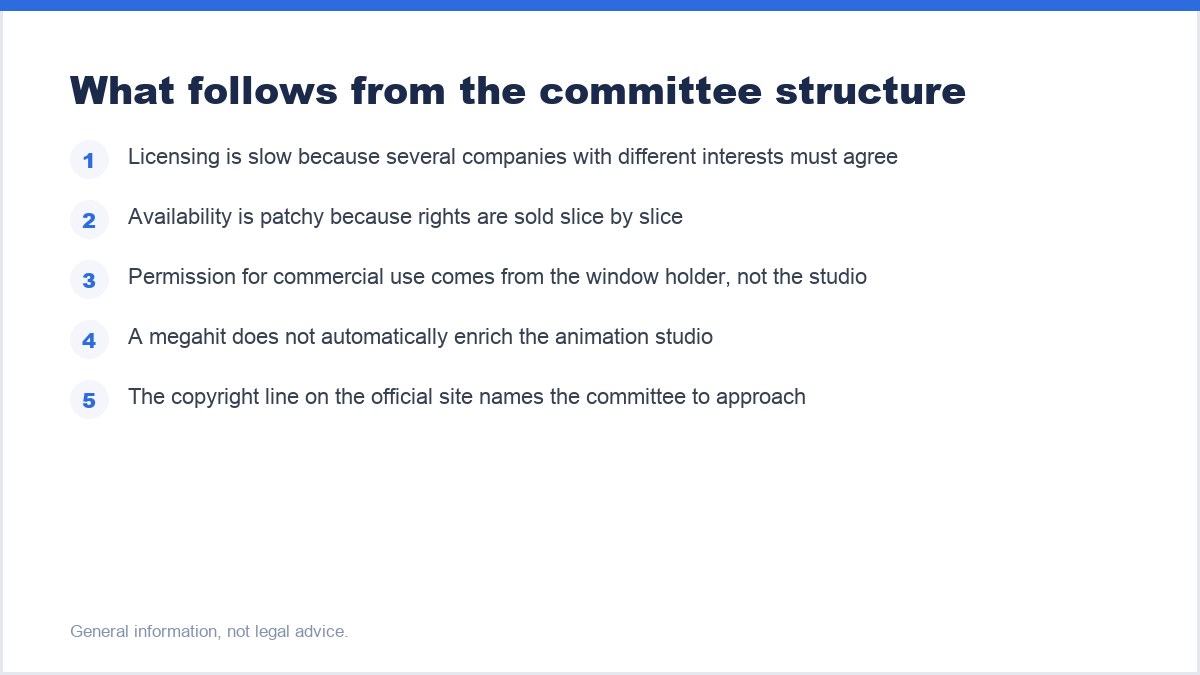
There was no one person to say yes. A single international deal may need several companies with different commercial interests to agree, and a member who sees no upside in your territory has little reason to hurry. This is also the root cause of region locking.
The studio usually owns nothing
Bones, MAPPA, Kyoto Animation, Wit, Madhouse and most of the other names fans recognise do not, as a rule, own the series they are famous for. They are contracted by the committee to produce the work for a fee. The fee is agreed before anyone knows whether the show will be a hit.
That is the structural complaint at the heart of a decade of arguments about animator pay. If a series becomes a phenomenon, the merchandise money flows to the merchandise window holder, the music money to the music label and the streaming money to the distributor. The studio has already been paid its production fee. It gets prestige and a stronger negotiating position next time, which is real but is not the same as a share of the upside.
There are exceptions, and they are instructive. Kyoto Animation runs its own publishing imprint so that it can originate source material it controls rather than adapting someone else’s. Studios increasingly try to buy a seat on the committee for shows they believe in, which converts them from contractor to part owner. Both routes require capital the typical studio does not have.

Where the manga publisher sits
If the anime adapts an existing manga or light novel, the publisher is in an unusually strong position before the committee even forms. The underlying work is theirs, and an adaptation cannot proceed without them. They typically join the committee, hold the print rights outright, and benefit from the adaptation regardless of how the anime performs, because an anime is the most effective advertisement a manga can have.
This is why publishers such as Shueisha, Kodansha and Kadokawa appear on so many committees, and why Kadokawa in particular, which publishes, produces and distributes, can occupy several committee roles at once.
The model is being challenged from two directions
The first challenge is vertical integration. Sony now owns Aniplex, the studio A-1 Pictures and Crunchyroll, which lets a single corporate group finance, produce and distribute a title worldwide without assembling a traditional committee at all. Kadokawa has built something similar around publishing.
The second is the global streaming commission. When Netflix or Amazon funds a series directly, it generally takes worldwide rights in exchange, and the committee either shrinks dramatically or never forms. Studios tend to like these deals because the budgets are larger and the payment is certain. The trade is that the studio still does not own the result, and a show made this way can be harder to exploit in Japan, where committees remain the normal route to broadcast slots and merchandise shelves.
Neither challenger has displaced the committee. Committees spread risk across companies that each have a different way to make the money back, and in a business where most titles do not recoup, that remains genuinely useful.
What to take from this
- The studio makes the show. The committee owns it. Credits distinguish the two.
- Rights are held in slices by different member companies, each with its own window.
- No single company can usually approve a deal that crosses slices, which is why licensing is slow and availability is patchy.
- Permission for anything commercial has to come from the right window holder, not from the studio and not from the creator.
- A megahit does not automatically make the animation studio rich, and that is a design feature of the structure rather than an accident.
If you are trying to work out who to approach about a specific title, the committee name in the copyright line of the official site is the starting point, and the distributor listed on an existing overseas release is usually the fastest route in.